"What is that?" Draco asked, looking at the small black object fitted in Hermione's ear, trailing a thin wire. It bore a passing resemblance to the Weasley twins' Extendable Ears, though considerably more compact.
They were sitting on a carved bench in a quiet corner of the sanatorium courtyard, taking advantage of the hour before their evening session with Slughorn. The night was still and clear, the garden lights flickering through the grass, the air carrying its usual mingling of rose and rain.
"Headphones," Hermione said. "A Muggle device. My grandfather gave them to ." She took one of the small round pieces from her ear and held it out.
Draco examined it. Tiny perforations across the surface, the word SONY on the back, connected by a thin black cord to a small rectangular device no larger than a deck of cards—also labelled SONY.
"A manufacturer's na?" he guessed.
"Yes. Try them." She was watching him with the barely-suppressed satisfaction of soone who already knows how the experint will turn out. "The sound quality is quite good."
"It won't do anything to my ear?"
"It's not a prank product, Draco."
He gave it one more sceptical look, then put it in.
A lody arrived—clean and full, nothing like the tinny sound he'd been prepared for. Then a voice, soft and unhurried:
t you by surprise, I didn't realise that my life would change forever.
Saw you standing there, I didn't know I'd care—
there was sothing special in the air.
Draco was genuinely surprised. This small, unprepossessing object was producing the kind of sound quality that required a large brass-horned gramophone in his world—and even then, not quite like this.
He glanced at Hermione. She was watching him with a knowing look, and there it was—the quiet smugness she deployed when she'd been proved right. He chose not to acknowledge it directly.
Dreams are my reality, the only kind of real fantasy.
Illusions are a common thing—I try to live in dreams,
it seems as if it's ant to be.
He stopped noticing the sound quality and started listening to the song itself.
Dreams are my reality, a different kind of reality.
I dream of loving in the night,
and loving seems alright, although it's only fantasy.
Sitting on a bench in a wizarding sanatorium at dusk, sharing Muggle headphones with Hermione Granger, was by any objective asure a thoroughly irrational thing to be doing.
Muggle technology, on the whole, was barely adequate, he thought.
This song, however, was sothing else. That probably explained why he was still sitting here.
"What is it called?" he asked quietly.
"'Reality.'" She had tipped her head back against the bench, eyes half-closed, her expression easy and unguarded. "It's the the from a Muggle film. Richard Sanderson."
If you do exist, honey don't resist—
show a new way of loving.
Tell that it's true, show what to do,
I feel sothing special about you.
Sitting with one's back against a bench rather than upright was not consistent with anything Narcissa had ever taught him about posture or comportnt.
Nonetheless, as if the song had quietly dismantled so governing principle, he found himself doing it anyway—sliding down until his head rested on the backrest, looking up at the darkening sky. He waited for it to feel wrong. It didn't. The tension in his shoulders, which he hadn't noticed carrying, loosened slightly.
Dreams are my reality, the only kind of reality.
Maybe my foolishness is past,
and maybe now at last I'll see how the real thing can be.
A night breeze moved through the garden. He turned his head to find the source of a faint scent, and found her—eyes closed, entirely absorbed, the faintest smile at the corner of her mouth.
He didn't make a sound, afraid to disturb whatever was happening.
Dreams are my reality, a wondrous world where I like to be.
I dream of holding you all night,
and holding you seems right—
perhaps that's my reality.
The breeze shifted again. Hermione felt it and turned her head, so thought half-ford on her lips—then stopped.
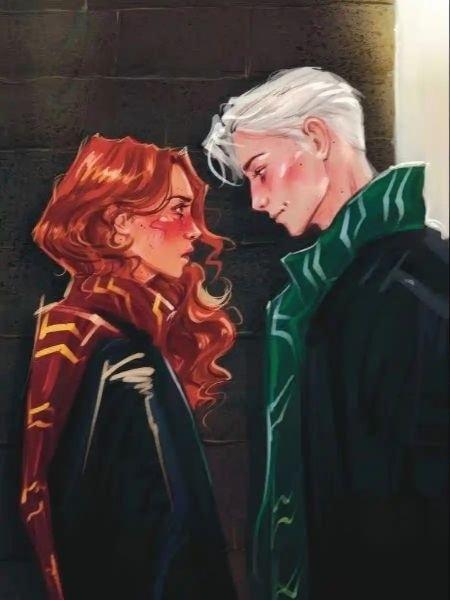
His face was very close to hers. He was looking at the sky, but as she turned, his eyes moved to et hers, grey and quietly bright in the evening light.
Those eyes.
She felt her smile disappear before she could catch it. Sothing tightened in her chest without explanation—the sa peculiar sensation as standing too close to the cauldron at Slughorn's, the warmth of his arm along hers, the feeling of being surrounded without being touched.
This was entirely irrational. The song had nothing to do with any of this.
t you by surprise, I didn't realise that my life would change forever.
Tell that it's true, feelings that are new—
I feel sothing special about you.
The lyrics drifted through her like warm water, and he was still looking at her. Then his expression shifted—from the rare, easy openness of a few monts ago into sothing more careful, more focused, as if he were working out a problem.
He was probably just listening to the words, she told herself. Or reconsidering his opinion of the headphones.
It had nothing to do with her.
Dreams are my reality. I like to dream of you close to .
I dream of loving in the night,
and loving you seems right.
Perhaps that's my reality.
When the song ended, Draco sat up, removed the earpiece, and returned it without comnt.
He had seen the change in her face—the easy smile giving way to sothing taut. He knew what it ant. She had realised she was too close and pulled back, the sa way she'd pulled back that morning in bed.
She didn't dislike him. He was fairly certain of that. But liking soone and wanting them that close were different things, and he had no right to push the boundary between them any further than she set it.
He was grateful for the ti they had. That was the honest truth.
"Beautiful, isn't it," he said, keeping his voice easy. "Shall we go back? I could do with so water."
"Yes—I am rather thirsty." She was looking at her palm where the earpiece now rested, with a slightly puzzled expression, as though sothing had startled her. She'd check the headphones for faulty wiring later, she decided.
They stood and walked back through the corridor without speaking. The silence wasn't unpleasant, but it was careful.
Draco cleared his throat. "What are your plans after this?"
"I'd like to stay in Bath a bit longer, actually." Her expression brightened imdiately. "This opportunity with Mr. Slughorn—it's genuinely rare. I don't want to leave before it's finished."
"You were originally only staying a few days," he said.
"I've persuaded Mum and Dad to postpone France until August." She sounded cheerful about this, if faintly guilty. "Dad was a little disappointed—he'd been planning the whole of July around the Dordogne, and there's a particular butcher's market in a village near Sarlat that he's been talking about for years—but Grandpa is delighted. He always wants us to stay longer."
"I imagine your grandfather is very pleased," Draco said, a slight smile at the corner of his mouth.
---
Three days after their first brewing session, they returned to Slughorn's apothecary to continue their work on the Felix Felicis.
Hermione was carefully separating petals from a pot of amaranth, counting them into a small dish. She had twenty-three ready, and was preparing to begin adding them to the potion's surface.
"Children—not all at once," Slughorn said, with the patient tone of soone who had watched students make this mistake many tis. "One petal at a ti. Wait until each has settled to the bottom before adding the next. Do you know why?"
"To observe the colour change more precisely?" Hermione ventured.
"Close. Can either of you take it further?" He looked at Draco.
Draco studied the amaranth plant—its blooms were notably full, the stems thick. "Amaranth petals are never a uniform size. We need to adjust the quantity based on what the potion's colour tells us, rather than add a fixed number regardless."
Slughorn clapped his hands with great satisfaction. "Exactly right! The original recipe specifies a quantity—but the amaranth used in the first recorded batch of Felix Felicis was not the sa size as what we grow today. Climate, season, growing conditions—all of it affects the petals. This is where the recipe begins to diverge from reality, and where brewers who follow instructions too literally start to fail."
He looked at them both and was clearly pleased by what he saw. "Every batch of Felix Felicis is, in a sense, unique. The sa potion brewed twice will require different quantities depending on the ingredients at hand. Descriptions like 'a few petals' or 'a pinch' must always be treated as guidelines, never absolutes. The potion will tell you what it needs, if you're paying attention."
Draco and Hermione both made note of this. Such a remark was worth recording.
They leaned in together over the cauldron and began adding petals, taking turns, watching each one spiral down through the red liquid.
On the twenty-second petal, the potion turned green.
"About what I expected," Slughorn said, unsurprised. "The petals were on the larger side—it's their peak season, and this sumr has been exceptionally good for them. In midwinter you might need two or three more."
Hermione was writing rapidly in her notebook. Draco glanced at her and felt the familiar, uncomplicated warmth of watching her do what she did best.
"The work from here is more straightforward," Slughorn said, settling contentedly into his armchair and picking up his ad—a bottle of oak-brewed blend Draco had brought him on their third visit. "Check the potion each evening, stir seven tis clockwise and twice counter-clockwise. Then wait. Twenty-five days, give or take." He bead at them. "Which ans you'll have so ti on your hands. Is there anything else you'd like to study while you're here?"
"Any potion?" Hermione asked.
"Any potion I know how to brew—which is most of them." He blinked at her pleasantly.
"I'd like to learn the Wolfsbane Potion," she said. "I've seen it in next year's textbooks. I know it's very difficult to prepare."
Slughorn inhaled sharply—not with displeasure, but with the particular expression of soone who has been presented with a more interesting challenge than they anticipated. "You'll be covering werewolves in third year, yes?"
He shook his head slowly, but his eyes were bright. "My students always choose the most difficult possible things to ask . Every single one of them." He patted his head with theatrical resignation. "You do know who invented it, I hope?"
"Damocles Belby, in the 1970s," Hermione said promptly.
"Damocles Belby!" Slughorn repeated, with the warmth of soone returning to a favourite subject. "One of my very best students. Exceptional wizard. Entirely deserving of his Order of rlin. That potion alone represented years of dedicated work, and he built most of the foundational theory from scratch." He paused for effect.
"I believe his achievents were greatly shaped by his formative training, sir," Draco said, with the precise degree of implication required. Slughorn's expression beca subtly, contentedly smug.
"In recent years, the Wolfsbane Potion hasn't attracted much research interest—most wizards will never have cause to use it," Slughorn continued, warming to his subject. "But I discussed the developnt of the original formula with Damocles in so depth, and I've since corresponded with Severus about possible refinents. And the ingredient sourcing alone—" He shook his head with modest pride. "Very few people have the connections I do."
Draco and Hermione exchanged a glance.
"However," Slughorn said, tempering his enthusiasm with sothing more asured, "before I can teach you the Wolfsbane Potion properly, you must first understand its component potions—the modifier, the enhancer, and the Calming Draught. They are the foundation. Master those, and the Wolfsbane becos comprehensible."
Relatively straightforward, Slughorn called them. Draco kept his expression neutral. None of those three potions were simple by any standard. Each one was closer to OWL-level work than anything a third-year had any business attempting. He thought this to himself and said nothing.
Hermione was already listening with the focused intensity she brought to things that genuinely excited her.
---
The following month settled into a routine that Draco found, unexpectedly, among the best of his rembered sumrs.
The Felix Felicis required only a brief check each evening—a few stirs, an observation of colour—and so their sessions with Slughorn beca primarily devoted to the foundations of the Wolfsbane Potion: the modifier, the enhancer, and the Calming Draught in turn.
The Calming Draught, which Slughorn described as "a little effort," required ingredients added in strict sequence, a precise number of stirs in alternating directions, and fla temperature maintained within a narrow range for an exact duration. If any single variable deviated, the whole batch failed. Draco, who had brewed it once before in his previous life and produced sothing resembling pale grey dough, gave it a quietly determined effort.
Hermione succeeded on her first attempt. A faint silver-white steam rose from her cauldron, delicate and unmistakeable.
"How?" Draco stared at it.
She turned and looked at him with so suspicion. "You think I couldn't?"
"I didn't say that. You're remarkable—more remarkable than , actually." He wiped the perspiration from his forehead with rather more composure than he felt.
"You're being ridiculous," she said, smiling. "We're both remarkable. We're partners, not rivals—don't let Slughorn tell you otherwise." She held his gaze. "My best study partner. There isn't another one like you anywhere."
"Right," he said. He looked down at his cauldron and began bottling his own—functional, if not as clean as hers. "I'm satisfied with that. It's good."
It was good. It was more than good. He just didn't quite know how to say so.
---
Slughorn had taken to inviting them to dinner after particularly successful sessions, and the table conversation over a month had introduced them to a considerable number of nas from his long career. Dirk Cresswell, currently at the Goblin Liaison Office. Barnabas Cuffe, editor of the Daily Prophet. Ambrose Swott of Honeydukes, who sent a gift basket every year without fail. Gwenog Jones of the Holyhead Harpies, who provided tickets in lieu of letters.
Slughorn also had a persistent interest in Harry Potter. This didn't surprise either of them. They told him what was already public knowledge: youngest Seeker in a century, well-regarded at school, had helped resolve the Chamber of Secrets incident. Slughorn received each piece of information with great enthusiasm and asked follow-up questions.
"We've never really understood," Hermione said one evening, when Slughorn had had slightly more ad than usual and the conversation had turned to Hogwarts faculty, "why Professor Snape seems so hostile to Harry. Harry has never done anything to provoke him."
Draco raised his eyes from his plate with mild interest. He'd long since accepted that Snape's inner life was impenetrable. But Slughorn—Slughorn knew almost everyone.
"Oh, that." The old man leaned back in his chair, his expression taking on the unguarded quality of a man temporarily relieved of his usual discretion. "Jas Potter and Severus detested each other at school. Always did. And in the end, Jas married Lily." He let the pause do its work. "She was Severus's closest friend, from childhood. So people said more than that."
Draco and Hermione looked at each other across the table.
Neither of them spoke for a mont.
---
They walked ho through the moonlit cobblestone streets, the usual route, the town quiet around them. Draco had taken to walking her back each evening, a habit that had established itself without either of them formally deciding on it.
"I never knew Professor Snape had a history like that," Hermione said at last.
"Neither did I," Draco said. He was still processing it. "Though it does explain a number of things." He paused. "Including why he's never used Sleekeazy's Hair Potion."
Hermione looked at him. "I beg your pardon?"
"Sleekeazy's was developed by Fleamont Potter. Harry's grandfather." He kept his voice entirely neutral. "Professor Snape would hardly choose to support his rival's family business."
Hermione stared at him for a long mont. "That... actually makes a kind of sense." She shook her head. "But that's not the part that matters."
"No." He watched the cobblestones. "What matters is that he treats Harry the way he treats him because Harry looks like Jas. He hates the father through the son."
"That's profoundly unfair to Harry," she said.
"Yes." He said nothing more for a mont. Then: "Don't say any of this aloud at school. Not if you want to keep your pumpkin juice safe."
"Obviously." She glanced at him sidelong. "I might ntion it to Harry, though. He deserves to understand why."
Draco nodded. He supposed that was true.
They walked for a while in companionable quiet. The moon was high, and the light it cast made the uneven paving stones look almost silver.
"Do you think Professor Snape hated her?" Hermione asked. "Lily. Eventually."
"I don't know," Draco said slowly.
"She married his enemy. From his perspective, that must have felt like a kind of abandonnt."
"Maybe." He thought about it properly. "But do you rember the Quidditch match in first year? He cast a counter-jinx against Quirrell—a sustained one. That kind of magic costs a significant amount of the caster's reserves, and the damage isn't always reversible." He glanced at her. "If you genuinely hate soone, you don't exhaust yourself protecting their son."
Hermione was quiet for a mont. "So you think he loved her."
The word arrived in the space between them and settled there.
Draco thought about Snape's perpetually shuttered, severe face. The careful, contained performance of a man who had spent decades in the company of a person who wanted him dead, maintaining an act that required everything he had.
If there had ever been love in it—and perhaps there had, perhaps that was the whole shape of it—then almost everything about Severus Snape that had ever seed incomprehensible suddenly made sense. The bitterness, the cruelty at small distances, the strange, oblique protectiveness he couldn't help but show in larger ones.
"I think," Draco said at last, looking down at the street, "he probably never wanted her dead."
Hermione turned to stare at him. "I am talking about love, and you're talking about death. I genuinely don't understand how Slytherin minds work."
He didn't answer.
He was thinking about Snape. About what it ant to want soone safe more than you wanted anything for yourself. About doing that quietly, without acknowledgent, for years.
He understood that more than he would have admitted.
The street was narrow ahead, the shadows long. Hermione walked quickly, absorbed in her own thoughts, unaware that he had slowed. He watched her from a few paces back—the way she moved, brisk and purposeful even on a deserted street at night—and felt the particular ache of knowing exactly what he felt, and knowing equally well that the feeling was entirely his own problem, and hers not at all.
He caught up with her without saying anything, and they walked the rest of the way in silence.







User Comments
0 comments from readers