After the incident at the Vistula River—after Zofia Nowak, her daughter Maria, and her son Tomasz—Oskar had returned to the Royal Palace of Warsaw.
There, within the vast front entrance hall, beneath the cold glow of electric light refracting through a grand crystal chandelier, he stood at the center of it all.
The hall itself had been transford.
No longer a place of ceremony, but sothing closer to a war workshop.
Steel. Tools. Movent. Purpose.
And at its heart was two giants.
Oskar and Shadowmane.
Both surrounded by scaffolding, reinforced stools, and even small lifting cranes brought in to handle the sheer mass of what was being assembled. The full reinforced steel plate armor—repaired and impossibly heavy—hung in sections around them, waiting to be fitted piece by piece.
The air itself felt heavier in that hall.
Not from the machines.
From him.
The won moved around him in dozens—fair skinned German won dressed in maid uniforms, dark dresses with white aprons, soft fabric clinging to youthful, well-kept forms. Their movents were careful, precise, almost ritualistic.
Reverent.
They did not rush.
They did not fumble.
They worked like attendants preparing sothing sacred.
Not long ago, many of them had been torn from their lives violently.
Cossack riders had co like a storm—howling, laughing, drunk on violence. Villages burned behind them, roofs collapsing in fire as n were cut down in the streets or dragged into the mud and butchered where they stood.
Fathers.
Brothers.
Husbands.
Dead before the flas had even finished rising.
And the won—
The won had been taken.
Dragged from their hos by the hair, by the arms, by whatever could be seized in the chaos. So had fought bravely. So had simply scread. So had just frozen in terror.
It did not matter.
They were thrown onto horses, into wagons, into the dirt—treated as spoils, as trophies of war, as things to be used like objects of value, or simply to clench the n's primal desires.
So had escaped that fate by chance, long enough to be rescued by Oskar and his n.
Others had not.
Those who had endured it carried it with them still, buried deep behind their eyes—sothing broken, sothing scarred, sothing that would never truly be made whole again.
Many had stood at the edge of ruin.
So had nearly stepped over it.
And yet, here they were. Still breathing, still alive and moving with hope in their eyes.
Reclaid from the jaws of that darkness. Now standing around him.
So had left, desperate to search for whatever fragnts of family might still remain in the wreckage of their old lives.
Most had stayed.
They stayed close to the man who had pulled them out of that hell, who had taken them from the hands of n who would have destroyed them completely.
The man who had given them sothing they had thought lost forever.
Not comfort.
Not peace.
But sothing stronger.
Purpose.
To them, this was no longer service.
It was devotion.
One of the girls stood before him on a raised stool, hands steady as she shaved the last traces of stubble from his jaw, shaping his face with care as if carving a statue. Another brushed his brows, adjusting every detail of his appearance until his features returned to that sharp, almost unreal perfection—dangerously handso, cold, precise.
Others moved across his body.
Hands smoothing the skin-tight synthetic black under-suit across his chest, down his arms, over his waist and legs. The fabric clung to him like a second skin, outlining every line of muscle, every unnatural proportion of his fra.
Their fingers lingered longer than necessary.
Not out of carelessness.
Out of awe.
Then the armour began.
Piece by piece.
Layer by layer.
Black plates rose and locked into place over him, each segnt sealed with weight and finality. Pauldrons the size of shields settled onto his shoulders. The breastplate—thick, reinforced, impossibly heavy—was lowered into place with the aid of a crane, locking over his chest with a dull, resonant sound that echoed through the hall.
Arms. Gauntlets. Cuisses. Greaves.
Each piece turned him further from man to sothing else.
Sothing mythic.
The sheer mass of it was staggering—over a hundred kilograms of hardened steel and engineered plating—yet as it settled onto him, he did not strain.
He accepted it.
Like it belonged.
Like it had always been ant to.
The won whispered as they worked.
Soft laughter.
Quiet admiration.
Their eyes followed him constantly—drawn to the sheer scale of him, the way he filled space even while standing still.
The way the air seed to tighten around him.
Nearby, Shadowmane stood as the sa process unfolded.
The massive warhorse, easily eight hundred kilograms of muscle and bone, was fitted with dark armour that transford him into sothing monstrous—plating across the chest, reinforced face guard, layered protection that gave him the appearance of sothing dragged from apocalyptic myth.
A black horse of the end tis.
Even the won moved more carefully around him.
Not out of fear.
Out of instinct.
Because both of them together, the man and the beast, felt like sothing that didn't belong to this world of mortal n.
The helt was brought forward.
Two won carried it together.
Carefully.
As if it was sothing fragile.
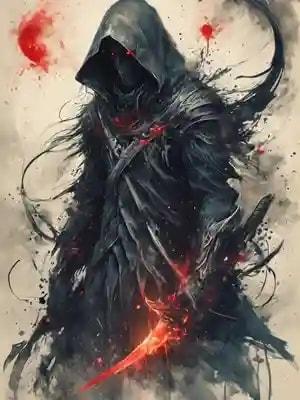
Oskar reached out and took the skull-faced helm.
For a brief mont, his bare face remained visible—cold, composed, distant.
Then he placed it on.
It locked into place with a hollow, final sound.
The man disappeared.
And the Iron Prince took it's true form.
The hall grew quieter.
Not silent.
But subdued.
As if sothing had just crossed a threshold.
His cold gaze shifted.
The sword.
Resting upon its stand.
Massive. Broad. A weapon that should have required two n to even lift properly—let alone wield.
He took it with one hand.
Effortless.
And slung it across his back, the blade sliding into the black sheath hidden beneath his long, blood-red cape. The fabric fell heavy and rich, nearly brushing the floor, barely concealing the sheer length of the weapon beneath it. The tal settled with a deep, grounded weight against him.
His left arm moved next—small, precise—locking the integrated grenade launcher along his forearm into place.
Six shots.
Loaded.
Ready.
Then ca the final piece.
The purity seal.
It was placed upon his chest with care, almost reverence. The won handled it as though it were sothing sacred, their voices lowering as they spoke its words softly, like a prayer given form.
The parchnt hung against the black steel, the script stark and unyielding:
In darkness, I am light.
In doubt, I am faith.
In rage, I am the blade.
In vengeance, I give no rcy.
In battle, I know no fear.
In death, I hold no remorse.
For a mont—
He stood still.
And the entire hall seed to tighten.
Not silence.
Pressure.
The kind felt before a storm breaks.
Before the sea rises and crashes against the land.
Before sothing irreversible takes shape.
Then—
He gave a small nod.
To the won.
A quiet acknowledgnt.
A silent thanks.
His expression did not soften.
But when one stepped too close—her hands lingering for just a second longer than they should have—he reached out, almost absently, and rested a gloved hand atop her head.
A simple gesture.
She froze instantly.
Then lowered her gaze.
Blushing.
He turned.
The red cape fell behind him like spilled blood, dragging through the air with slow, deliberate weight.
The Eternal Guard moved at once, parting as one, opening the massive palace doors without a word.
Light flooded in.
And as Oskar stepped forward, Shadowmane moved with him—no command given, none needed—over a ton of armored muscle and steel shifting in perfect unison.
The ground itself seed to feel it.
Together, they walked out into the afternoon.
Outside the Royal Palace, in the vast square where the Black Legion had stood only hours earlier, the stage still remained.
It rose from the stone like sothing planted there by force—dark, immovable, absolute. Heavy banners of black, white, and red hung down like funeral cloth, unmoving in the still afternoon air.
Above it, the imperial eagle lood—vast, iron, and rciless—its wings spread wide as if to claim the city beneath it.
Black-armored guards stood at its edges, unmoving, silent—less like n, more like fixtures of the structure itself.
This was no stage.
It was a throne.
And beneath it, the city gathered.
They ca from every direction.
Driven forward through the streets in controlled flows by lines of Black Legion infantry. Squads stood at every junction, every turn, every narrowing street, shouting short, sharp commands that cut through the noise.
"Forward."
"Keep moving."
"No stopping."
The words repeated, again and again, until language itself beca irrelevant.
Even those who did not understand knew what was required.
Move.
There was no chaos.
The Black Legion did not allow chaos.
Only pressure.
The streets had been reshaped into channels. Tanks stood at key intersections—hulking slabs of iron and steel—blocking entire roads, forcing the flow of people into narrower, controlled paths. Armored trucks idled beside them, engines rumbling low like restrained beasts. Motorized units sealed off side streets, redirecting the human tide with chanical precision.
Above it all—
they were watched.
On rooftops, dark figures stood motionless behind chimneys and broken parapets.
In shattered windows, rifle barrels rested in shadow.
In the bell towers of churches, high above the city, snipers lay prone in silence, their scopes trained downward onto the slow-moving sea of humanity.
Every angle covered.
Every movent observed.
The people could not see all of them—
but they felt them.
The weight of unseen eyes pressed down from above, as if the sky itself had turned hostile.
Warsaw—what remained of it—was being herded.
Nearly four hundred thousand souls.
The young.
The old.
n with hands hardened by labor.
Won worn thin by years of work and hunger.
Children clinging to sleeves, to coats, to whatever felt safe.
There was no distinction.
They were all moved forward.
Those who had wealth had already fled.
Those with influence had vanished days earlier, slipping out along roads that were no longer open to the rest.
And many of the city's young n were already gone—taken, transported east, swallowed into the vast machinery of the Russian war effort.
What remained were the ones who had nowhere else to go.
Workers.
Laborers.
Families who had endured because they had no choice.
Clothes worn thin.
Faces lined with fatigue.
So stood upright, stubborn in their dignity.
Others bent under the invisible weight pressing down on them.
Between the river and the city blocks, the crowd thickened.
What had been movent beca compression.
Bodies pressed shoulder to shoulder.
A mass no longer made of individuals, but of weight.
Children were lifted onto shoulders to breathe.
Old n and won found whatever space they could—benches, steps, patches of ground—and sat in silence, their eyes distant, their voices low and resigned.
The sound never stopped.
A constant murmur.
Questions whispered into nothing.
Nas spoken without answer.
Half-ford prayers carried away before they could be finished.
Fear moved through them—not loudly, not wildly—but steadily, like a current beneath the surface.
Because none of them knew why they had been brought here.
Only that they had not been given a choice.
And that sothing was coming.
Down the slope toward the Vistula, where the land dipped slightly toward the river, the mass grew densest. There, between the palace gates and the dark, fast-moving water, the pressure reached its peak.
Bodies packed so tightly that movent beca difficult.
Breath shared between strangers.
The river cut off one side completely—cold, relentless, uncaring.
On the other side stood the city.
Buildings.
Stone.
Occupied.
Every window.
Every rooftop.
Every shadow.
And even across the bridges, on the far side of the Vistula, black steel helts could be seen—small, distant, but unmistakable.
Watching.
Waiting.
There was no escape.
No path outward.
Only inward.
And as the movent finally ceased, the crowd settled into stillness.
Not calm.
Not peace.
But anticipation.
A suffocating kind of silence broken only by whispers and shifting feet.
All of them waiting.
For whatever would co next.
And that was when he ca.
Riding upon Shadowmane—his black steed—down the slope, through the palace gates, and into the sea of people.
The shift happened instantly.
No command was given.
No order shouted.
And yet the mass parted.
Bodies moved without thought, without coordination, as if sothing deep and instinctive had seized them all at once. Those closest stepped back first—then those behind them—until a path ford before him, widening as he advanced.
The sound did not vanish all at once.
It drained.
Slowly.
As if the sight of him pulled the words from their throats.
Voices faltered. Conversations broke mid-sentence. The murmur collapsed into sothing thinner, weaker—until all that remained was breath.
Waiting.
Watching.
Like prey frozen before sothing it did not understand, hoping—without knowing why—that rcy might exist.
He rode slowly through them.
Deliberately.
His head turned, just slightly, the hollow gaze of the skull helm sweeping across the crowd. To them, he seed impossibly large—more structure than man—seated atop Shadowmane, whose sheer mass and presence turned every step into sothing felt by all, even those who were far away and could not see it.
The beast moved like weight given life.
Each hoof step struck the cobblestones with a dull, heavy sound that seed to echo too deeply.
And what they saw on top of Shadowmane was not a prince, or a man.
They saw a black figure crowned in death.
A skull-faced knight, wrapped in a cape the color of fresh blood, mounted upon a dark beast that seed drawn from sothing older than war.
To many, it was not even a black knight.
It was scripture made flesh.
The Black Horseman of the coming apocalypse.
The bringer of famine.
Of judgnt.
Of the end.
The only thing that marked him as human were his eyes. Those ice cold, bright eyes.
Burning from within the hollow darkness of the helm.
And even that did not comfort them.
Because those eyes did not feel like life.
They felt too focused, too tense, too unforgiving.
To many in that mont, that was what he was. Not a man, but a warning.
Without a word, he guided Shadowmane to the center of the gathering, to a clearing of bare cobblestone where the crowd had forced itself back just enough to leave space.
There he stopped.
The afternoon sun fell upon him, bright and rciless, casting long shadows past him towards the Vistula river.
And within the crowd the pressure grew.
It pressed into lungs.
Into bones.
Into thought itself.
People struggled to breathe.
To think.
To understand what they were even looking at.
Those closest to him—the circle of people forced to stand before him—looked up, but when his gaze fell upon them, they flinched.
Eyes dropped instantly.
So turned their heads away.
Others lowered themselves, knees hitting stone—not in reverence, but instinct.
To try and appear smaller.
Less worth noticing.
As if that alone might spare them.
Even those further back, those who could barely see him between bodies and shoulders felt it.
Felt his presence.
Children pointed at him, and were imdiately silenced, hands clamped over their mouths.
Old n frowned, but did not speak.
Young n stared, jaws tight, fists clenched—but none stepped forward.
Won leaned into one another, gripping sleeves, arms, shoulders—anything to steady themselves against the trembling that had taken hold of them.
Because whatever this was—
it was not normal.
It was not sothing the world had prepared them for.
And then—
the beast turned.
Slowly.
Deliberately.
Shadowmane shifted beneath him, turning his massive fra until Oskar's back faced the palace—and his front faced the river, the open space, the gathered masses stretching around him.
The sun hung behind him now.
West at his back.
The palace rising in stone and shadow behind his towering form.
The afternoon light struck against his armour and died there—swallowed, dimd—leaving him as a silhouette carved in black against gold.
And before him—
the east.
Open.
Waiting.
His shadow stretched long across the cobblestones, cast forward into the mass of people like sothing alive, sothing reaching.
Darkness before him.
Light behind.
And then his arms rose.
Slowly.
Outward.
Deliberate.
Heavy.
Not a gesture of greeting.
A gesture of claim.
As if he were opening himself to what lay ahead.
As if he were welcoming the coming night.
The coming darkness.
His gauntleted hands turned slightly, angling outward—left and right—pointing not forward, but to the sides of himself.
The aning was not yet spoken.
But it was already understood.
People stepped back instinctively, and the world seed to pause.
Breath was held.
All sound and thought seed to halt in that mont.
And then, his voice ca.
"Move."
It did not rise.
It did not strain.
It struck.
A deep, crushing command that tore through the air like thunder breaking against stone—like the roar of sothing vast, sothing inhuman, sothing that did not need to shout to be obeyed.
People gasped.
So cried out.
Children flinched, mouths falling open in shock.
The sound rippled outward through the crowd like a wave.
For a heartbeat—
no one moved.
Then they noticed the aning in his hands.
The direction.
Left.
Right.
Understanding ca all at once.
And they began to move.
First those closest to him—stumbling back, tripping over one another, pressing away from his outstretched arms. Then those behind them, and behind them again, the motion spreading outward like a chain reaction.
Bodies recoiled.
Turned.
Shifted.
The mass did not dissolve—
it split.
Like a sea forced apart.
A line carved through it.
Widening.
Stretching.
Running in both directions as far as the eye could see.
People pressed themselves to either side, forming two vast walls of flesh and cloth and breath, leaving a clear path through the center.
Kiloters long.
A corridor cut straight through the city itself.
And Oskar, remained at its center.
Utterly unmoving.
The axis.
The point around which everything had broken and reford.
Like a blade driven into water, except this was not water.
This was humanity.
And it had parted for him.
Then Oskar smiled, a crooked smile beneath the skull-helm, the expression hidden from the world but felt all the sa.
It was a strange smile.
Not one of amusent.
Not one of joy.
But sothing sharper—sothing almost disbelieving, as if even he could not quite accept the shape of the words forming in his own mind. What he was about to say… what he was about to impose… even to him, it sounded absurd.
And yet—
he would say it anyway.
Because absurdity, when backed by absolute power, was no longer absurd.
It beca law.
He drew in breath to speak, but stopped as he felt sothing familiar pushing through the crowd behind him.
And then he heard her.
"Oskar—is that you!? What are you doing!? What's going on!? What are you!?"
Her voice cut through everything.
Frantic, yet striking in a way that no other voice in that suffocating mass could be to Oskar's ears.
And yet, Oskar rely raised one gauntleted hand.
"Silence."
The word ca like a hamr.
And the square obeyed even if they hadn't been speaking.
The noise, or whatever was left of it died instantly. Bodies recoiled, people stepping back without even knowing why, as if sothing invisible had forced them to yield.
Then he turned his head, only slightly.
Just enough to see her.
Zofia Nowak.
She stood there like sothing that did not belong among the rest.
The river had washed her clean, but it had not returned her to what she had been. Sothing had shifted—sothing deeper than grief, deeper than fear. Despite everything that had been taken from her, despite the loss that still pressed against her chest like a weight that would never fully lift, there was life in her again.
Not peace.
Not yet.
But sothing dangerous.
Sothing awakened.
Even now, breath still uneven from the rush to reach him, she looked at Oskar not as the others did—not as a monster, not as a harbinger of ruin—but as sothing else entirely.
As the one thing left standing.
The only pillar in a world that had collapsed beneath her feet.
Sothing to hold onto.
Sothing she wanted—needed—to trust.
Around her, the crowd was a stark contrast.
Grey.
Worn.
Hollow.
Faces drained of strength, eyes dulled by exhaustion and fear, bodies bent under the invisible pressure of what was unfolding.
But she—
she was not like them.
Her hair still clung damp against her skin, dark strands framing her flushed face, catching faint light where the rest of the crowd seed to absorb it. Her dress hung loose and disordered, hastily gathered, hastily worn, the marks of urgency obvious in every fold and crease.
She had not waited as he had told her to do.
She had not stayed where he had left her.
She had co to him.
And it showed.
The collar of her dress hung open, the fabric pulled apart just enough to reveal the deep line of her chest, the full weight of her body rising and falling with every breath. The cloth still clung faintly from where the river had soaked through it, tracing the curves beneath without sha—her waist, her hips, the living shape of her form standing in defiance of everything around her.
There was nothing composed about her.
Nothing controlled.
And yet she drew the eye.
Her neck bore faint marks, barely visible unless one looked closely—shadows against pale skin, impressions left behind that had not yet faded.
And her lips—
slightly parted.
Still soft.
Still rembering the taste of him.
She caught herself biting them lightly, as if to steady her breath, as if to silence the mory pressing up inside her—the closeness, the heat, the overwhelming presence that had left her shaken and breathless on the riverbank.
Her throat tightened.
A small, involuntary swallow.
And she forced herself to look at him again.
As if that alone might make sense of it.
Beside her stood Maria.
Younger.
Softer.
And in her own way—
even more striking.
She clung to her mother instinctively, pressing close, one hand gripping the fabric at Zofia's side as if anchoring herself there. Her posture was smaller, more withdrawn, and yet her presence could not be ignored.
Her face carried a faint, persistent blush—soft, warm against her pale skin—her lips parted slightly as she breathed, her chest rising unevenly beneath thin fabric that shifted with every movent.
Her large grey eyes—
never left him.
Not once.
There was sothing deeply feminine in the way she looked at him—not bold, not knowing, but drawn, uncertain, almost ashad of it and yet unable to turn away. A quiet curiosity, untouched and unrefined, sothing that had not yet been hardened by the world.
Sothing that made her stand out even more.
Together they did not belong to the mass.
They stood apart from it.
Like sothing untouched by the dulling weight that had claid everyone else.
And Oskar saw them.
Fully.
Clearly.
Of course he did.
But he did not allow himself to show it.
Not now.
Not here.
"Watch your mouth, woman."
His voice ca low.
Cold.
Controlled.
It carried through the silence with ease, cutting across the square without effort.
"Do not mistake my kindness for weakness."
A pause.
Heavy.
Deliberate.
"Know your place… and do not make remind you of it."
Zofia gasped softly, the sound catching in her throat, one hand rising instinctively to her chest as she reached for her daughter, fingers tightening as if she needed sothing to hold onto.
The words struck.
Not like anger.
Not like rejection.
But like sothing harder.
Sothing that pushed her back into place.
Maria flinched at once, pressing tighter against her mother, her fingers clutching harder, her body shrinking slightly—but her eyes still lifted, still searching him, still drawn despite everything.
They stepped back instinctively.
Like they had been corrected.
The mass swallowed them again, closing around them, pulling them back into the sea of bodies.
And Oskar turned away from them.
As if they ant nothing.
As if what had passed between them at the Vistula river had already been discarded.
Then he spoke to the people again.
"Now hear the good people of Warsaw, the Poles, the Jews, the Russians, the whole lot of you."
His voice settled over them like weight.
"I want to play a ga."
A ripple of confusion and fear passed through the crowd, as Oskar then continued.
"And this ga is called house."
He made a faint movent of his arm toward the palace.
"I now proclaim the palace to be my house… and this, all that I have conquered now is my land… And all of you… are my guests."
The word twisted in the air.
"And as good guests… you do as I say…"
A breath.
"…or you die."
The reaction ca instantly.
Gasps.
Sharp, involuntary.
So n clenched their teeth, jaws tightening with suppressed rage. Others stared, stunned, unable to even process what they had just heard.
But none spoke or dared to move.
Because sothing in the way he spoke, made it painfully clear to everyone that this was not a negotiation.
Zofia seed lost.
Her mind lagging behind the mont.
Her hands rose unconsciously to her neck again, fingers brushing those faint marks, as if grounding herself in sothing real—sothing recent—sothing that contradicted the man now standing before her.
Her lips parted.
A breath escaped her.
She could still feel him.
His presence.
The way he had held her in his powerful arms.
The way he had spoken so sweetly to her, and soothed her.
The way her body had responded to him despite everything.
And now that warm, kind man. He had turned into this thing in black armor.
It did not match.
It did not make sense to her.
It felt like two different n occupying the sa body.
And she didn't like it.
Not one bit.
Shadowmane struck the ground with his hooves, the heavy impact echoing through the stone beneath them, grounding the mont, sealing it.
Then Oskar spoke again.
"Now do not fear, the ga is infact quite simple."
His arm extended.
Indicating the line.
"And as my first command, I want to see only n before … on the eastern side of this line you have so kindly made for ."
Then behind him.
"And the won—behind ."
A pause.
"I do not care of age."
"I do not care of state of being."
"If you have nobody to give your children to… give them to strangers."
His voice did not change.
"I do not care."
The words hit harder than anything before.
"All must move… if they are not already where they need to be."
A breath.
"You have thirty minutes."
Silence deepened.
"And after that…"
His head tilted slightly.
"If you are found still being on the wrong side of your assigned place… then you will die."
The last words struck like a blow.
And the crowd ghasped in utter disbelief.
No one moved.
They simply stood.
Frozen.
So ready to shout.
So ready to resist.
Most unable to even understand what they were being told.
And before anything could fully form—
Zofia stepped forward again.
Drawn.
Unable to stop herself.
"Why, Oskar…?"
Her voice trembled, but it carried.
Clear.
Beautiful.
Alive.
"Why are you saying this…?"
"What's going on…?"
Her eyes searched him desperately.
"I don't understand…"
A breath.
"What are you doing…?"
Her voice cracked.
"Please… don't do this Oskar…"
She took another step.
Closer.
"Can't you see… you're scaring everyone?"
Oskar's eyes twitched in irritation—just once—beneath the skull-helm.
And to the horror of everyone present, he did nothing.
He did not shift in the saddle.
He did not speak.
He did not even acknowledge her again.
He simply sat there upon Shadowmane, unmoving, like a statue placed at the center of the world. And the clock continued ticking.
Until finally soone moved forward.
Not cautiously.
Not hesitantly.
He walked.
Straight past Zofia.
Straight past Oskar.
Close enough to be seen.
Close enough to matter.
His head turned once—just once—toward Oskar.
And the hatred in his eyes was naked.
Unhidden.
Alive.
Zofia reacted instantly.
"Tomasz!"
Her voice broke sharp through the air.
"Where are you going?! Co back here—right now!"
But Tomasz did not stop.
He kept walking.
Through the clearing between the masses of people.
Through the invisible weight pressing down on everyone else.
Until he reached the other side.
Only then did he stop and turn.
And look back at them.
At his mother.
At his sister.
"You chose your side, mother."
His voice wasn't loud.
But it carried the weight of accusation.
"And I have chosen mine."
His gaze lingered for a mont on her.
On the way she stood behind Oskar.
On her body that was still marked, still unsettled, still carrying traces of sothing he could not unsee, sothing that made his stomach turn and his chest tighten all at once.
Her collar.
Her neck.
Her skin.
The evidence of closeness that had no place in his world.
No place so soon.
No place at all.
Zofia froze completely.
The words struck deeper than anything Oskar had said.
Because this—
this was her son.
And in his eyes she could see it, his judgnt, and utter disgust.
And she had no answer.
At the sa ti all around, other people had also begun to move.
Slowly at first.
Then as more and more people moved, other's followed and their movent soon picked up speed.
Like a small ripple suddenly turning into a surge of movent.
People shifting, pressing, turning, pushing themselves into motion, driven not by understanding—but by fear, by instinct, by the crushing certainty that standing still held the possibility of death, while moving cost nothing but slight effort.
Zofia, her family of three had broken apart.
Swallowed.
Lost within the mass.
Bodies closing in.
Movent swallowing shape.
And still—
they rembered.
Not to co too close.
Not to cross him.
Not to challenge him.
Even in panic—
even in confusion—
they gave him space.
Because sothing in them understood—
he was the center.
Zofia stumbled with the movent, her hand gripping Maria instinctively, pulling her close, shielding her without thought.
And still—
she looked up.
Again.
And again.
Searching.
Desperate.
Her eyes finding him through gaps in bodies, through shifting shoulders, through movent and noise—
hoping.
For sothing.
A glance.
A word.
A sign.
Sothing of the man she had felt before.
Sothing to tell her—
she had not imagined it.
That she had not already lost him.
Maria stood pressed against her, her body leaning instinctively into her mother, her fingers clutching tight, her head lowered—but her eyes—
her eyes kept lifting.
Again.
And again.
Drawn.
Her cheeks still faintly flushed, her breathing uneven, her posture small and yielding, almost fragile in the way she stayed close.
And without realizing it, both of them obeyed him without a word.
Silently choosing not to step forward or speak again.
They did not challenge him.
They rely remained behind him.
Where he had ordered them.
And Oskar sat there, still as a statue watching the mass of people.
As if the sight of their fear made him feel nothing, as if he wasn't moved by any of it.
And yet—
beneath the armor sothing else entirely was happening.
He watched it all, and he felt it.
The sheer scale of it.
Hundreds.
Thousands.
More than tens of thousands.
Moving not out of loyalty as his people did, but out of fear.
Because he had spoken.
Because he had decided.
Because he had willed it.
The sensation was… overwhelming.
A strange, heavy pressure rising within him, filling his chest, his mind, his entire being with sothing that was not quite emotion—
but sothing close to it.
He could feel it, the raw, power of fear.
Absolute.
He had said a few words—
and the world had moved.
It felt unreal.
Like he was no longer standing within it, but above it.
Like he was not part of it anymore, but sothing shaping it.
A shepherd.
And they—
his flock.
It almost felt like divinity.
And that—
that frightened him.
Even as it thrilled him.
Then as minutes, tens of minutes passed, slowly.
The movent soon began to die down.
The surge began settling.
The mass reforming.
People finding their places—n separated to stand before him, won pushed back behind him, the shape of the crowd changing, aligning, reshaping itself according to his will.
Murmurs remained.
Soft.
Uncertain.
Frightened.
And Oskar felt then that it was enough.
His gaze lifted.
Toward the distance.
Toward the clock tower across the river.
He watched it.
asured it.
Counted the last few seconds.
Then, he looked back over them.
And spoke.
"Ti."
The word was quiet.
But final.
And in that sa instant—
the world broke.
Shots rang out.
Sharp.
Precise.
From rooftops.
From bell towers.
From darkened windows.
From places unseen.
Bullets tore into the mass.
Bodies jerked.
Collapsed.
Blood sprayed across stone and cloth and skin.
People scread.
High.
Piercing.
Uncontrolled.
Oskar turned his head slightly, just enough to see.
A man far behind him, stood trying to hide himself amongst the won with a scarf half-covering his head, and then in the next second, his head burst apart and he was simply… gone.
Nothing left but a burst of red and bone.
Elsewhere—
near the park benches, where Oskar guessed so stubborn fool had decided to sit instead of move, blood exploded outward as another figure dropped.
All around—
they fell.
n.
A few won.
Those who had hesitated.
Those who had resisted.
Those who had not moved.
The shots did not stop.
Not imdiately.
They ca in asured intervals. With controlled precision.
Until everyone was where they were ant to be.
And then the crowd began to break.
Not in their formation.
But worse.
Hysterical crying.
Sobbing.
Broken voices.
People clutching one another, shaking, collapsing, whispering prayers that no longer sounded like belief.
And Oskar remained unmoving.
At the center of it all.
User Comments
0 comments from readers