Once Vulkan's power armor captured Axion's attention, a series of tests comnced without the Lord of Drakes' knowledge.
Axion ticulously analyzed the Primarch's wargear and proposed a comprehensive suite of modifications. With the assistance of several Sapient Machine Automatons and technologies far beyond the grasp of even the Master of the Forge, the armor that had accompanied Vulkan for nearly twenty millennia was fundantally restructured.
A multitude of ancient technologies was integrated into its fra. This included an internal dual Quantum Energy Core system, which allowed for the total removal of the traditional power pack. Whether by personal preference or the enduring influence of his howorld, Vulkan selected an array of incendiary armants from a staggering list of tactical options. The armor was fitted with miniaturized variants of the Plasma Incinerator used by Destroyer-class Heavy Automatons, an enhanced-pattern Volkite Stormgun, and Sapient Bolt Assault Rifles.
As for lee combat, Vulkan remained steadfast in his belief that his hamr was the ultimate instrunt of war.
The armor's once-vulnerable joint structures were encased in reinforced alloy housings, while micro-gravitic compensators ensured that the suit, now nearly triple its original weight, remained as agile as ever. Artificially reconstructed muscle fiber bundles, derived from ancient archeotech, amplified the Primarch's strength more than tenfold. Supported by this new plate, Vulkan could theoretically upend a Leman Russ battle tank with a single hand.
This necessitated a noticeable increase in the armor's bulk. Vulkan had always been a giant among his brothers; now, clad in this new panoply, the Lord of Drakes' physical presence rivaled that of a Dreadnought.
The expanded fra allowed for even more auxiliary systems: individual void shields, nanite-repair units, an all-environnt adaptation module, and a dical suite pre-loaded with three doses of Panacea. While such tinctures were useless to the Iron n, for any biological organism, the dicine offered not only a massive surge of vitality but the capacity to knit together almost any biological trauma. It functioned as a battlefield nanite-repair module paired with an adaptive optimization array and a one-ti ergency charge.
Despite Vulkan's staunch protests, Axion eventually abandoned the attempt to install supplentary AI units within the suit. However, the armor, now augnted by a quantum heuristic core and optimized helm-sensor arrays, possessed Auspex and micro-cogitator capabilities that rendered the original systems obsolete.
Vulkan donned the armor, a literal pinnacle of technological synthesis, and tested his range of motion. The physical sensation differed little from his old plate, yet the response ti was markedly faster. As he moved, the bespoke suit rapidly calibrated itself to his physiology. The fluidity of his motions increased exponentially.
Axion watched the armor's teletry in silence. Once the data stabilized, the second phase of testing began.
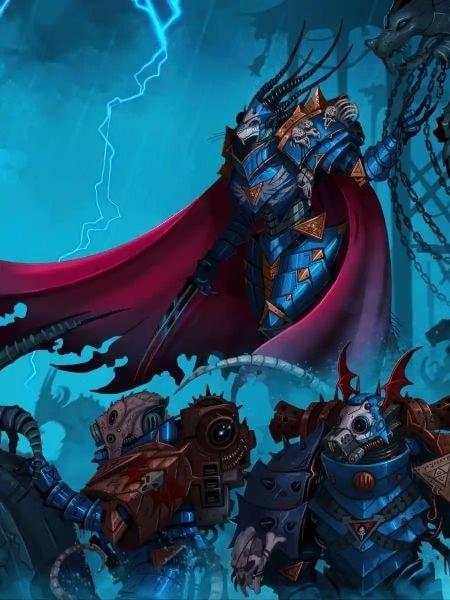
Vulkan divested himself of the armor, intending to perform "a few minor adjustnts" to bring it in line with his personal aesthetics. He planned to etch dragon-scale patterns into the bright silver surfaces, apply a livery of forest green and black, and reposition the fire-drake skull, the trophy from his legendary hunting contest with the Emperor, upon his pauldron.
Axion did not interfere, though he doubted Vulkan could leave even a scratch upon the reinforced plating using only a hamr and rudintary tools.
What followed defied all of Axion's logic.
Across the galaxy, on every chanical vessel where the new armor's design had been replicated for testing, the forms of the suits began to change in perfect synchronization with Vulkan's work. As Vulkan swung his hamr and applied his simple tools, carving precise lines and patterns into the silver alloy according to his aesthetic vision, the remote replicas mimicked the alterations in real-ti.
Under the gaze of countless monitoring devices, indentations and engravings manifested simultaneously upon the hardened shells of the distant armor sets. This sight nearly forced Axion's processing cores into a total system crash.
Clearly, the new wargear had been accepted by Vulkan. It had superseded the essence of his original armor within the Warp and had been "fixed" as a conceptual constant. The only individual capable of altering the essence of this panoply was Vulkan himself.
Witnessing this, Axion abandoned further testing. It was evident that continued experintation was futile. All data logs and reports were sealed; the phenonon was utterly beyond the Iron n's comprehension, it was fundantally "un-physical."
…
After several days of painstaking labor, Vulkan completed the aesthetic modifications to his armor. It was then that the Titan's Spear arrived.
Standing at a viewport in his new plate, Vulkan watched with profound shock as a colossal fleet transitioned out of the Warp. At that mont, he understood why Guilliman had chosen to allow these dangerous Sapient Machines to operate. The fleets of the Imperium were clearly incapable of contesting an enemy of this magnitude.
Vulkan had witnessed the Orks' massive war machines during the war on Ullanor, the ga-Gargants and battle-fortresses hollowed out of entire planets. But reflecting on what he had seen during his stay here, he realized one truth: those fortresses could not withstand these Titan-class vessels, and the Orks' crude "engines" would be no match for these slaughter-machines.
Yet, the reality was more complex. As a warrior-race engineered by the Old Ones to combat the Necrons, the Orks' technological ceiling remained an unknown variable. Had the Old Ones not fallen so swiftly before the Orks were "finished," the Necrons of this galaxy might have been eradicated long ago. After all, conventional technology relies on the laws of physics, while the technology of the Old Ones relied entirely on "imagining" a solution.
If the Old Ones "imagined" that Ork technology could defeat a C'tan or a Necron, the Greenskins' minds would be flooded with the power to manifest technology they didn't even understand. It was even possible that every Ork could have eventually ascended to an existence akin to Gork and Mork. During the War in Heaven, even the four Dark Gods dared only to remain in slumber; the Old Ones were the true masters of the Empyrean. Had those minor "godlings" erged then, the Old Ones likely would have snuffed them out with a casual thought.
…
The gargantuan hulls of the Void Sword and the Titan's Spear were soon tethered by countless cables. A massive tal corridor, kiloters wide, was constructed to bridge the gap between the two behemoths.
At the prompting of an automaton, Vulkan departed from the Void Sword alongside a vast chanical army, crossing over to the Titan's Spear. Though the corridor stretched for thousands of kiloters, rapid transit in the vacuum of zero-gravity was a simple matter. The passage was lined with gravitic regulators; by utilizing a series of gravity wells with varying vectors, objects entering the corridor were launched like projectiles. It was a marvel of efficiency.
After traversing a fixed distance, the gravitic influence slowed the travelers down, allowing them to reach their destination in re tens of minutes.
——————
If you want to read ahead of everyone, go to my pat-reon: pat-re-on.c-om/magnor (remove the hyphen to access normally)








User Comments
0 comments from readers